Card values, hard hands and soft hands
Every decision in blackjack starts with knowing what your total is and whether your ace can still change. This guide explains hard and soft hands, how often you will be dealt a blackjack, and which dealer upcards are weakest.
In brief
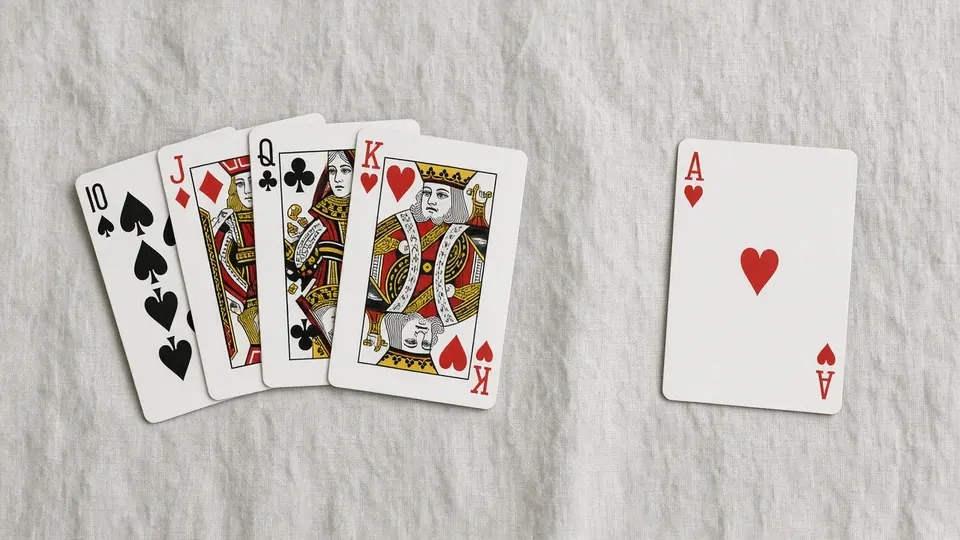
A hard hand has no ace, or an ace that must count as 1. A soft hand has an ace counting as 11, so it cannot bust on the next card. About one hand in twenty-one is a blackjack.
Counting the cards
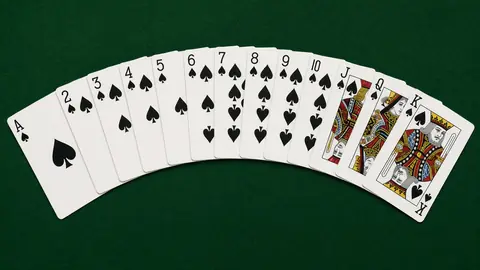
The rule is short. Number cards are worth their number. Jack, queen and king are each worth 10, as is the ten itself. The ace is worth 1 or 11. Suits never matter in standard blackjack, only in a few side bets and variants.
Because four of the thirteen ranks count as ten, ten-value cards are the most common. In a fresh deck, 16 of the 52 cards are worth ten, which is about 31%. That one fact explains most of basic strategy: you should assume the unseen dealer card is a ten more often than any other single value.
Hard hands
A hand is hard if it contains no ace, or if every ace in it has to count as 1 to avoid busting. A 10 and a 7 is a hard 17. An ace, a 6 and a 10 is also a hard 17, because counting the ace as 11 would give 27.
Hard hands can bust. A hard 12 busts if you draw a ten-value card, which happens about 31% of the time. The risk climbs with each point:
| Hard total | Chance one more card busts you |
|---|---|
| 12 | 4 in 13 (about 31%) |
| 13 | 5 in 13 (about 38%) |
| 14 | 6 in 13 (about 46%) |
| 15 | 7 in 13 (about 54%) |
| 16 | 8 in 13 (about 62%) |
| 17 | 9 in 13 (about 69%) |
These figures treat all thirteen ranks as equally likely, which is a close approximation for several decks.
Soft hands
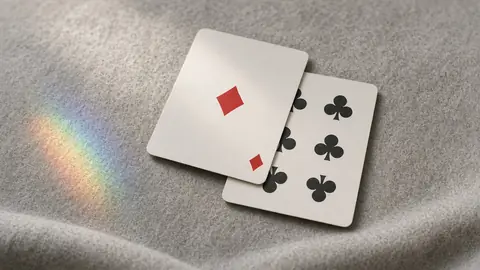
A hand is soft if it contains an ace that is currently counting as 11. An ace and a 6 is a soft 17 (it could also be a hard 7). You cannot bust by taking one more card, because the ace can drop to 1 if needed. That is why many soft hands are good candidates for doubling or hitting. Soft hands has the full rules of thumb.
A soft hand can turn hard. Soft 17 plus a 9 gives 26 if the ace stays at 11, so the ace drops to 1 and you hold a hard 16.
Blackjack versus 21
Only an ace and a ten-value card as your first two cards is a blackjack (also called a natural). A hand that reaches 21 with three or more cards is just 21. A blackjack beats other 21s and normally pays 3 to 2.
Your chance of being dealt a blackjack is about 4.7% to 4.8%, depending on the number of decks, or roughly one hand in twenty-one. With one deck it is a little higher, 4.83%. With very many decks it approaches 4.73%.
After splitting, an ace plus a ten-value card usually counts as an ordinary 21, not a blackjack, and is paid 1 to 1. Rules vary slightly by table, so check the help screen.
The dealer's upcard
Since the dealer must draw to 16 and stand on 17 or more, you can work out how often each upcard ends in a bust. These figures are calculated for an infinite deck with a dealer who stands on all 17s:
| Dealer upcard | Dealer busts |
|---|---|
| 2 | 35.5% |
| 3 | 37.5% |
| 4 | 39.6% |
| 5 | 41.6% |
| 6 | 42.3% |
| 7 | 26.2% |
| 8 | 24.5% |
| 9 | 22.8% |
| 10 | 21.2% |
| Ace | 13.8% |
The 6 is the weakest upcard and the ace and ten the strongest. That is why basic strategy tells you to stand on a stiff 12 to 16 against a dealer 2 to 6 and to hit it against 7 to ace. You are not hoping to improve a bad hand, you are letting the dealer bust.
Quick answers
Is a ten-value card the same as a ten?
For counting, yes. A king and a ten both give 10. For splitting, some tables only let you split cards of the same rank, so a king and a queen may not be splittable even though both are worth 10.
Can an ace be worth 11 and 1 in the same hand?
In a hand with two aces, one can count as 11 and the other as 1, giving a soft 12. Two aces both counting as 11 would be 22, a bust.
What is a stiff hand?
A "stiff" is a hard total of 12 to 16, where one card can bust you but standing will usually lose.
Keep reading
 How blackjack worksBlackjack looks simple: get closer to 21 than the dealer without going over.
 Soft handsA soft hand contains an ace counted as 11.
 Basic strategy chartBasic strategy is the best possible play for every hand against every dealer upcard, for a given set of rules.
 Blackjack glossaryBlackjack comes with its own vocabulary, and tables, rules screens and strategy guides use it without explanation.