House edge and return to player, explained
The house edge is the average share of each bet the casino expects to keep over the long run. In blackjack it can be low, but only if you know the rules and play correctly. This guide explains the numbers and gives you a calculator for your own expected cost.
In brief
With good rules and perfect basic strategy the house edge is often under 0.5%. Poor rules, side bets and playing by hunch push the cost up fast. The edge is an average, not a promise for one session.
What the house edge means
The house edge is the average amount the casino keeps from each unit you wager, over a very large number of hands. If a game has an edge of 0.5%, the casino expects to keep 50p of every £100 you stake, on average, in the long run.
Return to player (RTP) is the same thing seen from your side: 100% minus the house edge. An edge of 0.5% is an RTP of 99.5%.
Note what these figures are measured against. They apply to the total amount wagered, not the amount you deposit. If you bet £10 a hand for 200 hands, you have wagered £2,000, even if you only ever had £100 on the table at once. The edge acts on the £2,000.
Why blackjack has an edge at all
Win, lose and push frequencies in a typical six-deck game with fairly liberal rules and perfect basic strategy come out at roughly 42.4% wins, 8.5% pushes and 49.1% losses, according to published simulations by Michael Shackleford (the "Wizard of Odds"). You lose more hands than you win. Your better payouts on blackjacks, doubles and splits pull the overall result back to a house edge of about 0.28% under those very generous rules.
The root cause is the order of play, which is explained in How blackjack works: you must act first, and a bust ends your hand before the dealer plays.
What moves the edge
These approximate effects come from the same analysis and are measured against a baseline of eight decks, dealer stands on soft 17 and double after split allowed:
| Rule | Effect on the player's return |
|---|---|
| Blackjack pays 6 to 5 instead of 3 to 2 | −1.39% |
| Dealer hits on soft 17 | −0.22% |
| Single deck | +0.48% |
| Two decks | +0.19% |
| Four decks | +0.06% |
| Six decks | +0.02% |
| Late surrender allowed | +0.08% |
For a sense of scale, the same source gives 0.43% for "Atlantic City rules" (eight decks, dealer stands on soft 17, up to four hands after splitting, double after split, late surrender). A table that pays 6 to 5 for blackjack costs more than three times the whole edge of that game. More detail is in table rules and decks.
Mistakes cost far more than rules
The Wizard of Odds has also published the cost of three famously bad habits: never hitting if you might bust costs about 3.91% of every bet, copying the dealer about 5.48%, and always assuming the dealer has a ten in the hole about 10.03%. Compare that with the fraction of a percent at stake from rule choices, and it is clear why learning the basic strategy chart is the biggest single step. See common mistakes.
Side bets such as Perfect Pairs and 21+3 usually carry edges of several percent, as multi-hand and side bets explains.
An average is not a forecast
The house edge describes the long run. In a single session, results swing widely. One hand has a standard deviation of roughly 1.14 times your bet under strategy-perfect play. Over 100 hands the typical swing is about ten times that of one hand (the square root of 100), which is 11.4 bets, far larger than the expected loss of half a bet at a 0.5% edge.
That is why somebody can win on a good night, and also why no short run proves a system works. Blackjack myths picks apart the common misreadings.
Calculate your expected cost
Use this to estimate the average cost of a session. It uses only the three numbers you enter.
This is a rough guide for planning how much you are comfortable spending, not a forecast. Real sessions will be higher or lower. If any number leaves you uncomfortable, spend less or do not play.
Quick answers
Does the edge apply to my deposit or my bets?
To your total bets. The more hands you play and the bigger your bets, the larger the average cost.
Is a 0.5% edge good?
It is low compared with most casino games, but it is still a cost. It is not a way to make money.
Do online tables have a different edge?
The edge depends on the rules, not whether the table is online. Check the rules screen at each table.
Keep reading
 Table rules and decksTwo blackjack tables can look identical and have very different odds.
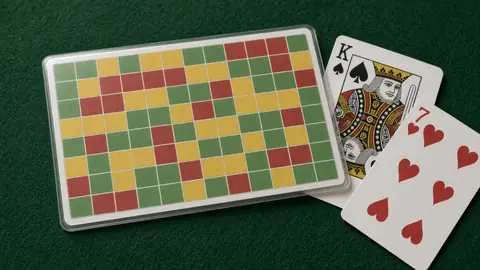 Basic strategy chartBasic strategy is the best possible play for every hand against every dealer upcard, for a given set of rules.
 Common mistakesMost of the money players lose to avoidable errors goes on a short list of habits.
 Blackjack mythsBlackjack attracts more folklore than almost any other game.