Splitting pairs: the rules for every pair
Splitting turns one hand into two, with a second bet. It is the most misunderstood move in blackjack. The rules are simple once you know the reasons: some pairs start two good hands, others turn a good total into two poor ones.
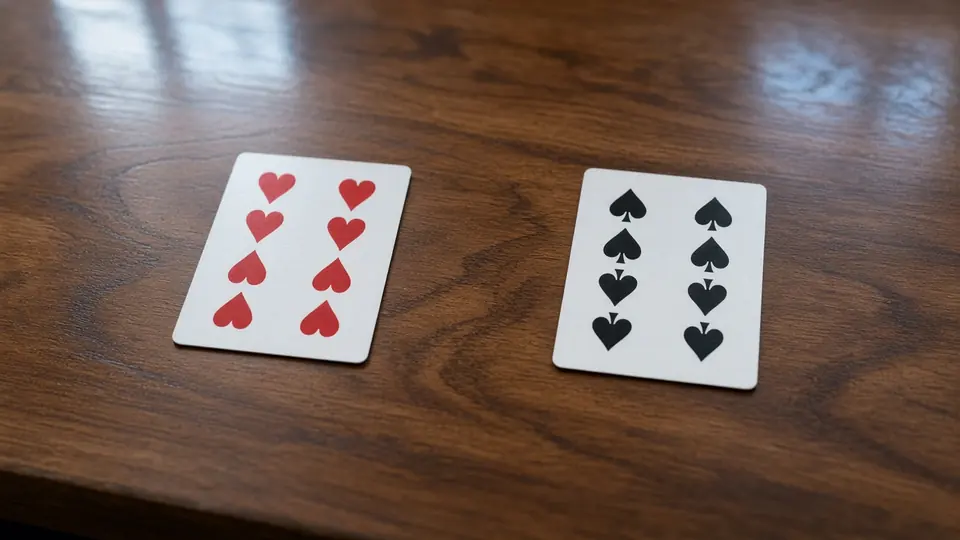
In brief
Always split aces and eights. Never split fives or tens. For other pairs, split against weak dealer cards and play as a hard total otherwise.
What happens when you split
If your first two cards have the same value, you can split them. You place a second bet equal to the first, and each card becomes the first card of a separate hand. You then play the hands one at a time, hitting, standing or (if allowed) doubling as normal. Rules differ on splitting again, doubling after a split (DAS) and on split aces. Check table rules and decks.
Split aces normally receive just one more card each at most tables. A ten-value card on a split ace usually counts as 21, not a blackjack, and pays 1 to 1.
The pairs, one at a time
Using the basic strategy chart for four to eight decks, dealer stands on soft 17, double after split allowed:
Aces and eights: always split
A pair of aces is a soft 12, a weak hand, but each ace is the best starting card. A pair of eights is a hard 16, the worst total in blackjack. Splitting gives you two hands starting from an 8, which is much better than one 16. Always split both, against any dealer card.
Fives and tens: never split
A pair of fives is a hard 10, which is a great doubling hand. A pair of tens is a hard 20, and splitting it breaks up a hand that wins most of the time. Treat them as hard totals.
Nines
Split against a dealer 2 to 6 and against 8 or 9. Stand against a 7, because 18 beats the likely dealer 17, and against a 10 or ace.
Sevens
Split against a dealer 2 to 7. Hit against 8 to ace.
Sixes
Split against a dealer 3 to 6, and against a 2 if double after split is allowed. Otherwise hit.
Fours
Split only if double after split is allowed and the dealer shows 5 or 6. Otherwise hit.
Twos and threes
Split against a dealer 4 to 7, and against 2 or 3 as well if double after split is allowed. Hit otherwise.
Summary table
| Pair | Split against |
|---|---|
| A,A | All dealer cards |
| 10,10 | Never |
| 9,9 | 2 to 6, 8, 9 |
| 8,8 | All dealer cards |
| 7,7 | 2 to 7 |
| 6,6 | 3 to 6 (and 2 with DAS) |
| 5,5 | Never (play as 10) |
| 4,4 | 5 and 6, only with DAS |
| 3,3 and 2,2 | 4 to 7 (and 2, 3 with DAS) |
Resplitting and limits
If you split and are dealt another card of the same value, you may be able to split again, up to a limit such as four hands in total. If you cannot split because of the limit, play the hand as a hard total, with one exception: if you cannot resplit aces and you are allowed to draw to split aces, double against a 6, otherwise hit.
Why splitting needs a bigger bankroll
Splitting creates a second bet, and doubling after a split can create more. Plan stakes so that several splits and doubles in one round are within your limit. If you cannot afford to follow the chart, lower your stake per hand rather than skip correct plays.
Common mistakes
- Not splitting eights because you feel the 16 is already "something".
- Splitting tens because they look strong.
- Splitting fours or fives for no reason.
Quick answers
Why not split tens when I could win twice?
Because a hard 20 already wins most hands. Splitting turns that into two hands that are each less likely to win.
Can I split any two ten-value cards?
It depends on the table. Some require the same rank. It rarely matters because you should not split tens.
What if split aces are not allowed to be hit again?
That is the normal rule, and the chart already assumes it.
Keep reading
 Basic strategy chartBasic strategy is the best possible play for every hand against every dealer upcard, for a given set of rules.
 Doubling downDoubling down means doubling your bet in return for exactly one more card.
 Table rules and decksTwo blackjack tables can look identical and have very different odds.
 Soft handsA soft hand contains an ace counted as 11.